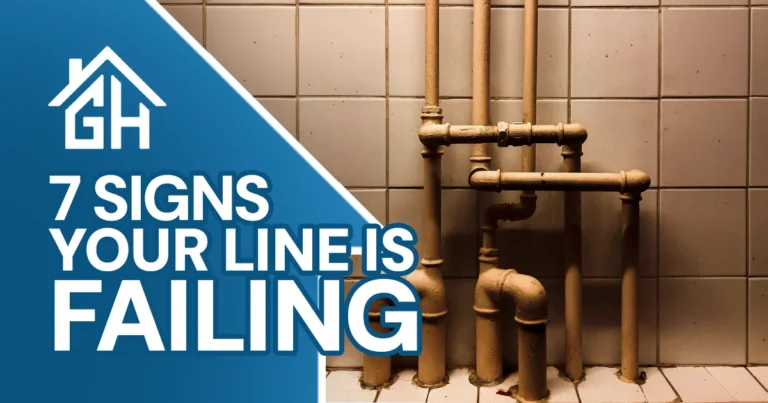
A clog that keeps coming back usually isn’t bad luck. Here’s how to tell when the sewer line itself is failing, and what to check before you spend a dollar on the fix.
Sewer line problem or just a clog?
Most slow drains are just a clog in that one fixture. The signs below are different. They point to the main sewer line, the single pipe that carries everything out of your house to the street.
Watch for these seven signs:
- Sewage backing up into more than one drain
- Gurgling toilets
- Sewer odors
- Soggy or sunken spots in the yard
- Recurring clogs
- Sewer pests
- An older iron or clay sewer line
A single sign does not necessarily mean the line needs replacement. A sewer camera inspection can help determine what is happening inside the pipe.
1. Sewage backs up into more than one drain
When you flush the toilet and water rises in the tub or shower, the problem is in the main line and not the toilet. Every drain in your house empties into that one pipe. If it’s blocked or broken, wastewater has nowhere to go, so it comes back up through the lowest openings first: the tub, the shower, or a floor drain.
Here’s the quick way to sort it out:
- One slow sink or one stopped-up toilet is usually a local clog. Our clogged toilet help covers that.
- Two or more fixtures backing up at the same time points to the main line.
- A backup that gets worse when the washer drains or someone showers points there too.
If sewage is coming up into a tub or floor drain, stop running water in the house and call a plumber. This one doesn’t clear up on its own.
2. Toilets and drains gurgle when you run water
A toilet that gurgles when the shower runs, or a drain that bubbles when the washer empties, means air is getting pushed back up through the pipes. That happens when water can’t flow out freely, usually because something in the line is slowing it down.
Customers often call it a “gargling” toilet. It tends to show up before a full backup does, which makes it one of the better early warnings you’ll get. Once after a big load of laundry is a sign it’s worth watching. Every day, or in more than one fixture, means it’s time to look inside the line.
3. You smell sewer gas inside or in the yard
A rotten-egg or sewage smell with no clear source can mean a crack in the sewer line is letting gas escape. Check the easy fix first though. Every drain has a P-trap, a curved section of pipe that holds a little water to block sewer gas. In a guest shower or floor drain nobody uses, that water can dry out. Run the water for a minute and see if the smell fades.
If it doesn’t, notice where the smell is strongest:
- near a floor drain or the base of a toilet
- outside, near the cleanout (the capped pipe sticking out of your yard)
- along the path the line runs from the house to the street
A smell outside the house, especially in one spot, points to the line itself.
4. Soggy, sunken, or extra-green patches in the yard
Sewage feeds grass, so a leaking line often shows itself in the yard above it. Walk the path from your house to the street and look for:
- a soft or soggy spot when it hasn’t rained
- a sunken dip or a low spot shaped like a trench
- a strip of grass that stays greener than the rest of the lawn
That last one is easy to spot in a dry Texas summer, when most of the yard is brown and one line-shaped patch isn’t. Standing water with a sewage smell is an even stronger sign. A leak underground keeps washing out soil the longer it runs, so it pays to catch it early. This is the kind of underground pipe work we handle.
5. Clogs keep coming back after you clear them
A clog that comes back a few weeks after it was cleared usually means something inside the line is catching waste. Clearing it gets water moving again, but it doesn’t fix the cause. The usual culprits:
- Tree roots: Roots grow toward moisture and work their way into cracks and loose joints, especially in older clay and cast iron lines.
- A belly: A section of pipe that has sagged holds water and waste instead of letting it run downhill.
- A broken or collapsed section: Waste snags on the rough edges every time it passes.
If you’ve paid to clear the same line two or three times in a year, you’re paying for the symptom over and over. Before you pay for another clearing, find out what’s actually in the pipe.
6. Rats, roaches, or sewer flies show up
A sudden run of roaches, drain flies, or rats in the house can trace back to a broken sewer line. Sewers are full of them, and a crack or a gap at a joint gives them a way in.
Watch for:
- sewer flies (small, fuzzy drain flies) hovering around tub and floor drains
- roaches coming up near drains or the cleanout
- rats around the foundation or crawl space
Pest control will take care of what’s already inside. If the line is open though, more will keep coming.
7. Your home still has its original iron or clay sewer line
Sometimes the biggest sign is just the age of the house. Plenty of DFW homes built in the 1970s and earlier still run on the sewer line they were built with, and those lines were usually cast iron or clay. Cast iron rusts and scales from the inside until it cracks. Clay pipe tends to crack and let roots in at the joints.
The median home in Garland was built in 1978. In Greenville it’s 1979, and in Farmersville it’s 1980. A house that age still has its original sewer line unless someone has already replaced it.
Customers usually describe it as “old iron pipes.” In our experience, those older homes are where sewer line replacement comes up most, and homes built after 2000 with plastic lines see it far less. If you have an older home in Greenville or Farmersville and keep dealing with sewer problems, a camera inspection can show whether the original line needs repair or replacement. If your home is that age and you’re seeing any other sign on this list, the pipe itself is the likely problem.
What to do next: get a camera inspection before you decide
A sewer camera inspection shows exactly what’s wrong with the line and where. We run a camera down the pipe, find the break, root mass, sag, or blockage, and show you the footage so you see what we see. When you call us for a stoppage, the camera inspection is included at no charge.
That one step keeps you from paying for the wrong fix. Skip it, and you’re either clearing the same line again and again or guessing at a replacement you might not need.
Repair or full sewer line replacement?
What the camera finds decides the fix:
- Spot repair: A single crack, one bad joint, or one root intrusion in an otherwise solid line can often be fixed in that section alone.
- Full replacement: Corrosion along the whole run, several breaks, a collapsed section, or a belly that keeps catching waste usually means repairs won’t hold, and replacing the line is the right call.
We’ll tell you straight which one you need and why. If your line has years left in it, we’ll say so. If it’s time for full sewer line replacement, we’ll walk you through the job before any work starts.
Talk to a plumber who’ll tell you straight
When you call Good & Honest Plumbing, you reach the people who do the work, not a call center. Caleb runs the jobs himself, and we’re licensed (Texas license M#43536) and insured. Every complete sewer replacement comes with a 10-year warranty.
Seeing any of these signs? Call (972) 965-4818 and we’ll get a camera in your line. You can also read what our customers say or look over our full sewer repair and replacement services.
Call (972) 965-4818
Frequently asked questions
Does homeowners insurance cover sewer line replacement?
Usually not when the line simply wore out. Most standard homeowners policies exclude damage from age, corrosion, and tree roots, the cause behind most sewer line failures. Some insurers sell a separate service line endorsement that does cover it. Call your agent before work starts so you know what you’ll pay out of pocket.
How long does it take to replace a sewer line?
It depends on how long and how deep the line runs, and what sits on top of it, like a driveway, a patio, or mature trees. Most of the time goes into digging and backfilling, not the pipe itself. After the camera inspection, we’ll give you a timeline for your specific line before you commit.
Do I need a permit to replace my sewer line?
In most DFW cities, yes. Replacing a sewer line is plumbing work that usually needs a city permit and an inspection before the trench gets filled back in. Your plumber should be the one pulling the permit and scheduling that inspection. Ask about it up front when you get a quote.
Who is responsible for the sewer line, me or the city?
In most cities, you own the service line that runs from your house out to the city’s connection, and the city owns the main line under the street. Where that handoff sits varies by city. If the problem turns out to be on the city’s side, call your city’s utility department.
Where is my sewer cleanout?
Look for a short capped pipe sticking out of the ground within a few feet of your foundation, often on the side of the house closest to the street. Some homes have a second one near the property line. Knowing where it is gives your plumber a quick way into the line.